Let's take a breather from all of the AI news, shall we? And talk about another interesting subject - satellites!
A week ago I was hiking in Tahoe, pulled out my iPhone with zero bars, and sent a message to my service (www.satjourney.com) via a satellite. The whole ordeal took less than a minute, and most people probably don't know they have this capability on the phone currently in their pocket. Yes, satellites are very interesting, they're here to stay, and they're going to become a lot more useful come next year! Let's dive in...
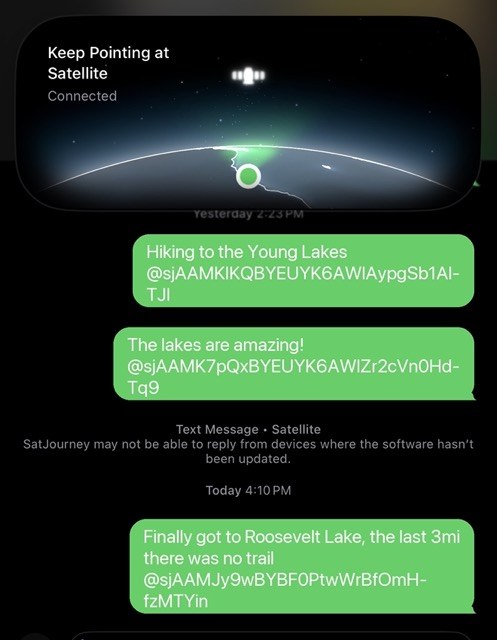
Ubiquitous satellite connection for places with no terrestrial cell signal is already here. Right now there are four ways to use it:
The latest Apple and Android phones have satellite connectivity built in. Text messages only, and it currently costs $0.
External devices that provide a rudimentary connection over satellites, pair with your phone over Bluetooth, and can send text messages (the newest Garmins do photos and voice notes too) and call emergency services, for $15–20 a month. Garmin inReach, ZOLEO, SPOT. The device itself runs $200–400.
Verizon and T-Mobile have plans that let you text over satellites. T-Mobile's T-Satellite connects your phone straight to Starlink, is included in their top plans, and costs $10 a month as an add-on for everyone else, including customers of other carriers. This one also lets a growing list of approved apps use it: WhatsApp, AllTrails, Google Maps, and a dozen others.
Or you can buy a Starlink Mini that fits in a backpack, around $50 a month plus $350–500 for the box. It draws 25–40 W, so you need real batteries. Great in a car or on a boat, not so great on your back.
Only #4 gives you the high-speed connection we're all used to, but it's bulky and expensive. On 1–3 you won't be browsing or watching YouTube, but you can chat with your friends and family.
At this time options 1 and 3 are the ones to watch because they're useful and usable - they need nothing but the phone. The industry calls this "direct to cell" (D2C) and it's the simplest of the four because there's no extra box to charge, carry, or forget.
Apple, Google and AT&T don't run satellites... just yet! But some of them are about to start. Here are the major satellite operators as of now:
Iridium. The network under most Garmin inReach devices. In beta with a standards-based service that lets modern phone and IoT chips talk to its satellites directly, no proprietary radio required.
Globalstar. Apple's satellite partner, which is being bought by Amazon for $11.6 billion. Soon Amazon will be providing Apple with its satellite comms. Oh, the irony. And Amazon isn't stopping there: in July it filed with the FCC for its own 5,000-satellite direct-to-device constellation, deployment starting 2028.
Skylo. Owns no satellites at all. It leases capacity on existing geostationary satellites and runs the 3GPP standard for narrowband satellite, so any modern phone chip can talk to it. It's the service behind Pixel 9 and 10, Galaxy S25 and S26, the Pixel Watch 4, and Verizon's satellite texting. The quiet one nobody has heard of, in a lot of pockets.
Starlink. SpaceX paid about $17 billion for EchoStar's spectrum last September so Starlink can talk to phones on its own frequencies instead of borrowing a carrier's. It has more than 650 direct-to-cell satellites up, service in 22 countries, and it went public in June at a valuation north of $1.7 trillion. Direct-to-cell was a headline in that pitch.
AST SpaceMobile. The new kid on the block. It has 13 of its very large BlueBird satellites in orbit, is launching three at a time every couple of months, and is backed by AT&T, Verizon, and Vodafone. Beta service in the US before the end of this year, and a separate European-controlled constellation with Vodafone.
And then there's Apple, the interesting quiet one. All year the reporting said the iPhone 18 Pro would carry Apple's own modem with 5G satellite support. The September event mentioned none of it, just that the current text-only service stays free for another year. Either it's not ready, or Apple is waiting for the right Satellite network to present itself. My money is on the second.
So what happens next? Here's my take.
Satellite becomes a line on your phone bill, not a device you buy. Texting gets bundled into most US plans by the end of 2027. Data will be metered and pricey at first, then bundled the way roaming was. The carriers know it, which is why they're buying stakes in constellations instead of just signing contracts.
2027 is the year, not 2026. Starlink's next-generation satellites need Starship and are slated for the second half of 2027. AST says commercial service in the first half of 2027. Amazon's Globalstar deal closes in 2027. This year is betas and press releases. Next year your phone quietly starts doing it.
The dedicated messenger moves upmarket. inReach doesn't die. It becomes what a mechanical dive watch is to a diver: the thing you carry when failure is not an option. Garmin will sell fewer of them to weekend hikers and more to people who cross oceans, and they'll be fine.
Apps stay locked out for another year or two, then the door opens all at once. Today a carrier decides which apps get satellite data, one at a time. That's 2007, the year before the App Store. Apple is reportedly building a framework to let any app use satellite. When that ships, the allowlists go away and the interesting products get built by people who don't work at a carrier.
Three constellations survive: SpaceX, Amazon, AST. Europe and China run their own. Apple ends up a customer, not an operator. Everyone else gets bought or becomes a spectrum holding.
And the one I care about most: the connection stops being the product. Today "works over satellite" is a feature you can charge for. In two years it's a checkbox, like "works on Wi-Fi." What's left is what you do with the message once it arrives. That's the bet behind SatJourney: the connection is becoming free, the story you send over it is not.